TL;DR: Measuring AI voice agent performance requires moving past traditional call center metrics. The leading solutions for tracking voice agent KPIs focus on outcomes: Conversion, Containment/FCR, Cost per Qualified Outcome, and CSAT. Setting up a structured dashboard cadence ensures you optimize for revenue, not just talk time. HUMREP AI provides a built-in, out-of-the-box dashboard to track these critical business metrics in real time.
Most businesses deploying AI voice agents start by looking at the wrong numbers. They track the total number of calls or raw transcription accuracy. But in 2026, leading solutions for tracking voice agent KPIs and metrics focus entirely on business outcomes.
A high answer rate means nothing if the AI cannot qualify a lead. A low average handle time (AHT) is dangerous if the AI is simply dropping calls instead of resolving issues. To evaluate your AI voice operations properly, you need a comprehensive, multi-layer measurement framework.
Here is the definitive guide to tracking AI voice agent performance, complete with metrics, formulas, and an operating dashboard cadence.
1. Top-of-Funnel: Reach & Engagement
Before the AI can sell or support, it must connect and keep the user on the line.
Answer Rate
The percentage of outbound dials that result in a human picking up and saying "hello".
- Formula:
(Calls Answered by Human / Total Calls Dialed) × 100% - Target: 15–25% (highly dependent on industry and caller ID reputation).
Drop-off Rate (First 10 Seconds)
How many people hang up immediately after hearing the AI's opening line.
- Formula:
(Calls Dropped < 10s / Total Connected Calls) × 100% - Why it matters: A high drop-off rate means your AI sounds robotic, or the opening script is too aggressive. The HUMREP voice engine uses native audio technology to eliminate latency, drastically reducing immediate hangups compared to traditional text-to-speech systems.
2. The Core: Business Outcome Metrics
This is where leading analytics solutions separate ROI-positive AI deployments from expensive experiments.
Conversion Rate & Qualified Lead Rate
For outbound sales, how effectively does the AI move a cold prospect to the next stage?
- Formula (Conversion):
(Successful Outcomes / Total Connected Calls) × 100% - Formula (Qualified):
(Leads Meeting BANT Criteria / Total Conversations) × 100% - Benchmark: A well-tuned AI should achieve a 3–8% qualification rate on cold lists, rivaling human SDRs. Read more in our AI vs SDR Real Math analysis.
Booking Rate
If the goal is setting meetings, this is your ultimate north star.
- Formula:
(Meetings Booked / Total Connected Conversations) × 100%
Cost per Qualified Outcome (CPQO)
US-based platforms charging per-minute can severely distort this metric. A 10-minute discovery call on a $0.15/minute platform costs $1.50 just for infrastructure.
- Formula:
(Total Platform Cost + Telco Costs) / Total Qualified Leads - The HUMREP Advantage: With HUMREP starting from €500/month for unlimited call potential (no per-minute traps), your CPQO decreases as your volume scales.
3. Operations & Customer Experience (CX)
For inbound customer service and support, the KPIs shift from conversion to resolution.
Containment Rate & First Contact Resolution (FCR)
Does the AI resolve the customer's problem without human intervention?
- Formula:
(Issues Resolved by AI / Total Inbound Conversations) × 100% - Target: 60–80% for standard tier-1 support tasks.
Average Handle Time (AHT)
The total time the AI spends on the call.
- Formula:
Total Talk Time / Number of Connected Calls - Warning: Unlike human agents, AI doesn't get tired. A longer AHT isn't necessarily bad if it leads to higher FCR and better CSAT. Don't optimize for short calls; optimize for complete resolutions.
Handoff Rate & Reasons
When the AI transfers a call to a human, why did it happen?
- Formula:
(Calls Transferred to Human / Total Conversations) × 100% - Tracking the reason (e.g., complex edge case, emotional distress, system limitation) is crucial for updating your AI's knowledge base.
CSAT & NPS
Customer Satisfaction and Net Promoter Score can be gathered automatically by the AI at the end of the call, or via follow-up SMS.
- Formula:
(Promoters - Detractors) / Total Responses
Compliance Metrics
Essential for finance, healthcare, and enterprise logistics.
- Metric: % of calls where mandatory legal disclaimers (e.g., "This call is recorded") were successfully spoken and acknowledged.
- Metric: PII redaction success rate (ensuring credit cards or health data aren't saved in plain text transcripts).
The KPI Dashboard Operating Cadence
Having the data isn't enough; you need a structured review cadence. Leading solutions for tracking voice agent KPIs recommend the following operating rhythm:
| Cadence | Focus Area | Key Metrics Reviewed | Owner |
|---|---|---|---|
| Daily | Health & Uptime | Answer Rate, Drop-off Rate, Handoff Spike Alerts | Operations Lead |
| Weekly | Script & Logic | Conversion Rate, FCR, Handoff Reasons | Sales/Support Manager |
| Monthly | ROI & Strategy | Cost per Qualified Outcome, CSAT/NPS, Infrastructure ROI | Director / VP |
(Table 1: The standard operating cadence for AI voice agent analytics)
External researchers, like Hamming AI and CallSphere, emphasize that looking at semantic intent accuracy and latency daily is required during the first two weeks of deployment, after which teams can move to a weekly outcome-focused cadence.
The HUMREP Analytics Advantage
While third-party tracking tools exist, bolting an analytics platform onto a disjointed AI system is complex and expensive.
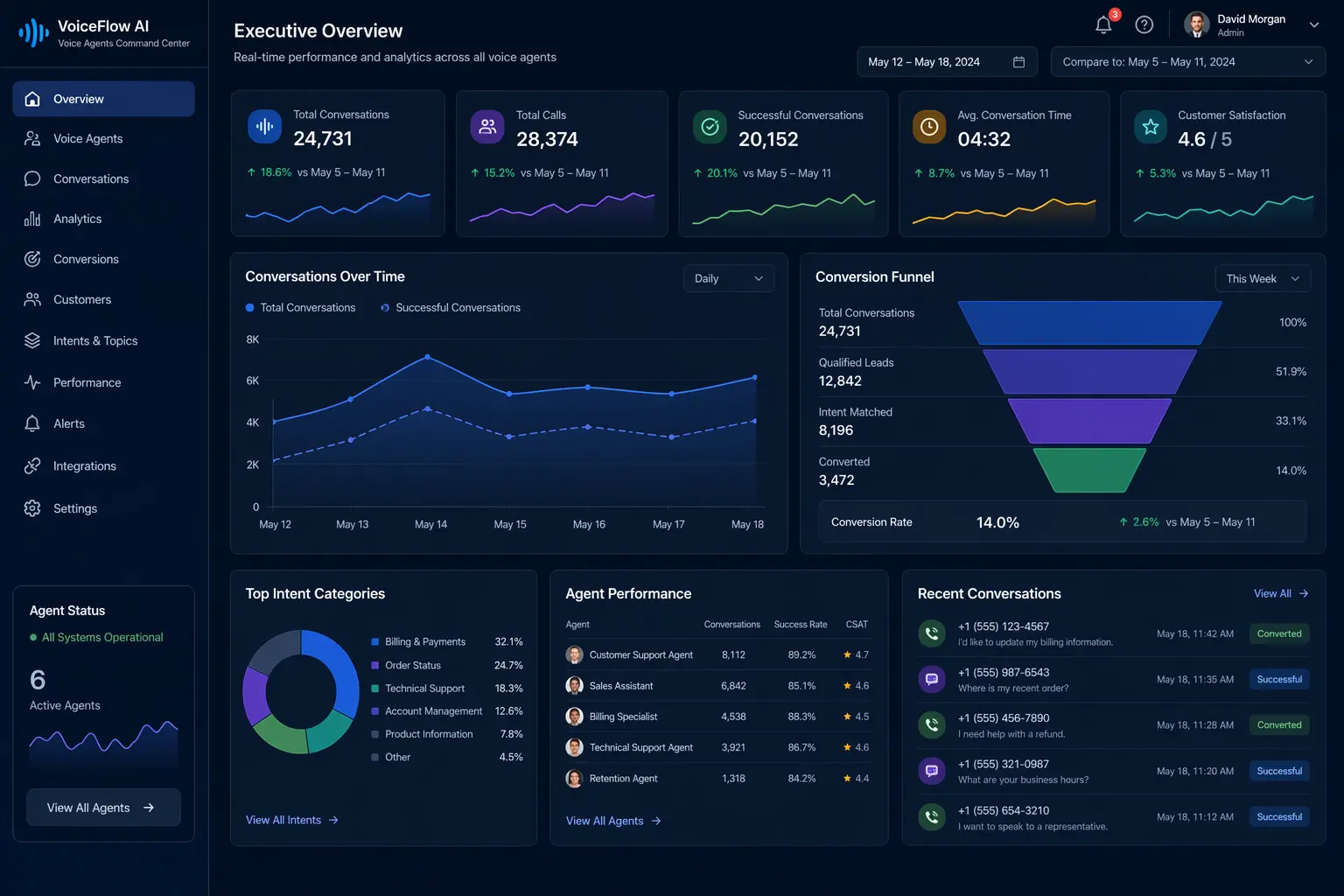
The HUMREP platform provides an integrated, out-of-the-box dashboard built directly into your operations command center. Because HUMREP controls the entire pipeline—from the native HUMREP AI engine to the telephony integration—our dashboard doesn't just show you that a call failed; it shows you why.
- Real-time Call Transcripts: Review exactly where users drop off.
- Custom Goal Tracking: Define what a "Qualified Lead" means for your business, and HUMREP tracks it automatically.
- Transparent Costs: Starting from €500/month, your ROI tracking is predictable, unlike US-based per-minute billing models (see our HUMREP vs AInora comparison) where an unexpectedly long conversation destroys your margins.
By combining native intelligence with clear, outcome-based reporting, HUMREP ensures you never fly blind.